
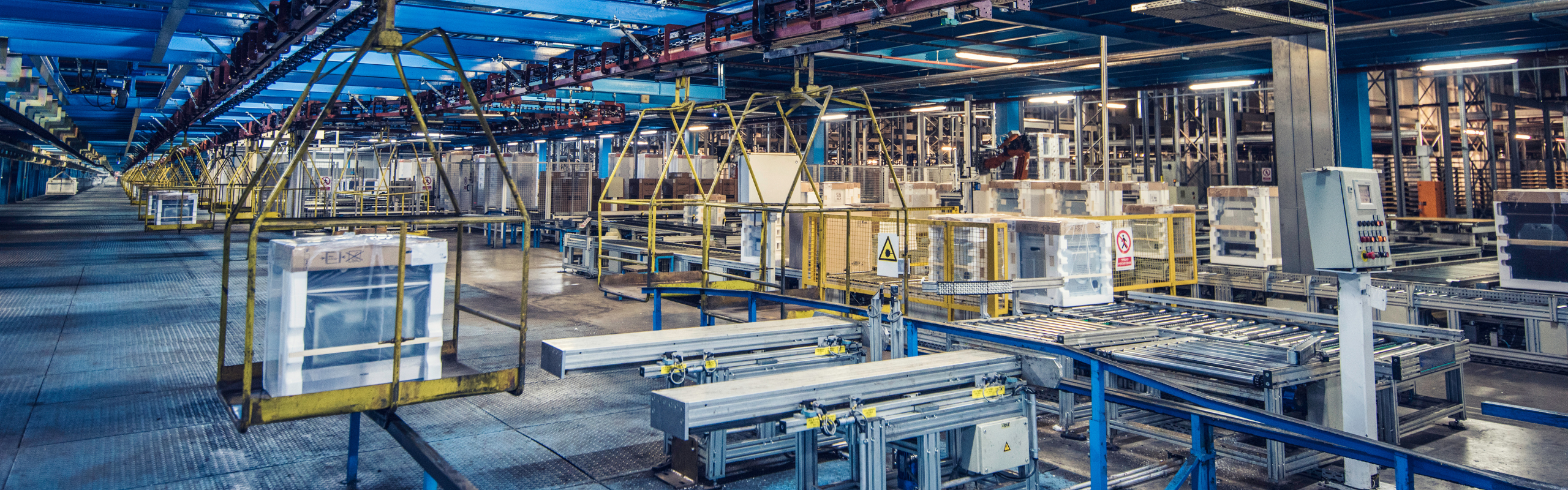
Products moving on production line

Managing Defects on the Fly. How do MES Systems Optimize the Handling of Defective Products?

The occurrence of defective items in production is an everyday reality for every factory. The key to maintaining profitability is not only preventing errors, but also the ability to properly manage them when they do occur. This process is supported by modern MES (Manufacturing Execution System) class systems, which enable advanced defect handling. Thanks to this, operators can classify and manage non-compliant products without interrupting ongoing production.

Precise Classification of Defective Products

Traditional systems often force employees to simply mark damaged parts as "defects". This, however, blurs the picture of what is actually happening on the production line. This approach is prevented by Production Execution in the Operator platform.

The Production Execution module is an MES terminal that becomes a communication channel between the production hall and the system. In addition to comprehensive production reporting capabilities, the terminal enables advanced waste reporting (so-called outsort management). It supports the disposal process while simultaneously allowing for the introduction of all corrections, performing repairs, and handling so-called re-work products.

The result? Operators gain the ability to accurately determine the causes of errors. Because of this, subsequent quality analysis becomes a solid foundation for minimizing material losses.

5 Paths for Dealing with a Defective Product

Managing defects on the fly requires a flexible approach. The Operator system offers five main classification paths for units that require additional intervention:

  • Direct Repair – a feature that enables direct repair of a defective part without interrupting ongoing production. The operator can repair the product on the spot and immediately return it for further processing.
  • Repair – involves repair actions at the production workstation, but they are performed at a later time. This can occur, for example, after the completion of the current production run.
  • Rework – otherwise known as reworking defective goods. This allows you to modify products and give them a new material code or create entirely new products.
  • Scrap – the final classification of a product as waste that is unsuitable for further processing or repair.
  • By-products – these are elements or semi-finished products created during the manufacturing of the main product. Parts classified this way can be effectively utilized in future production processes.

Defects on the Fly – How to React Quickly?

When we free operators from the necessity of working at stationary terminals, quality management becomes much faster. The Operator Mobile App enables the registration and classification of production waste directly at the workstation. In turn, the Quality Control module guarantees immediate quality monitoring at all stages of production.

Mobile solutions also facilitate access to data on quarantined products. Thanks to this, it is possible to report test results and streamline their release process.

Why Is This So Important for the OEE Indicator?

Entering the causes of rejections and errors in real-time provides invaluable information for the entire factory. It allows for a comprehensive analysis of production quality on an hourly or shift basis. Furthermore, the precise identification of defective batches will allow for targeted product recalls and cost reduction.

Treating quality defects as an inherent element of the process and implementing tools to manage them on the fly is a huge step towards Industry 4.0. Instead of stopping the entire line, employees can act in a planned manner. In the future, the data collected in the MES system will allow for the elimination of bottlenecks in the area of quality.

Do you want to check how such a solution will work in your factory? If you are in the process of looking for a system to optimize production, we invite you to contact us and schedule a demo.

Comments (0)

Leave your comment

No comments here yet, start first!

Leave your comment
Add the comment

You may also read:

When It’s 30°C Outside and… 1500°C in the Hall. MES in an Extreme Environment

Summer heat can take its toll, as we have recently experienced firsthand. But what about people working physically in a production hall where machines can heat up to over a thousand degrees Celsius? One of the largest iron foundries in Europe – Vald. Birn – operates in such conditions. Vald. Birn is a Danish company with a century-old tradition; its origins date back to 1893. Currently, the enterprise employs 1,000 workers across four factories, producing up to 3,000 different assortment items in the field of metal castings. Their clients include key automotive brands such as Volvo and Mercedes. The metal products themselves – often critical from a safety point of view – must absolutely meet rigorous quality requirements. In such a demanding and (especially during the summer) extreme environment, there is no room for errors. That is why the digitalization of production turned out to be crucial. Replacing Binders with an IT System For many years, production management at Vald. Birn relied on sheets of paper. Leif Jensen, the company’s Financial Director, admits that “sticky notes and kilometers of binders” piled up everywhere on the desks. This significantly slowed down the documentation process and also caused limitations in data access. Furthermore, the company made the decision to completely overhaul its ERP system. However, it turned out that the previous program was too much of a challenge for the operators working directly on the foundry floor, who were not accustomed to handling complex IT interfaces. Therefore, they needed something more intuitive to use. An MES System Resistant to 1500 Degrees To solve this problem, in parallel with the implementation of the main ERP system, the company launched the Operator MES software. Currently, it acts as an agile extension of the Infor M3 business system in a harsh production environment. Block Quote The implementation itself was a massive logistical undertaking. Inside the foundry, among crucibles heated to 1500°C and heavy machinery, a staggering 170 terminals were successfully deployed. The analysis department, located directly on the production hall, became the central point to which samples flow continuously via a special pneumatic tube system. In the laboratory, the composition of 20 different alloys is verified (including the content of elements such as titanium, lead, copper, and zinc). All results of these measurements immediately go to the Operator Platform, where they are automatically linked to specific customer orders. How to Achieve a Defect Rate Below 2% The management of Vald. Birn considers the implementation of the Operator system a “great success from day one”. The project brought results that permanently revolutionized the daily functioning of the foundry. Among the greatest benefits the company noticed were: Paperless approach – the paper documentation system was completely eliminated. Instead, the registration of orders, processes, and quality measurements was automated. Full Traceability – by ensuring strict quality control, the defect rate (scrap rate) was maintained at a level below 2%. Error identification – this process was significantly simplified and accelerated, facilitating an immediate reaction to irregularities. Audits – the company reached a completely new level of process documentation. This resulted in an official commendation from the Bureau Veritas auditors during certification. Intuitiveness That Builds Data Discipline Importantly, the success of the project was determined not only by the technology itself, but by its reception by the employees – including those who were not previously used to IT solutions. Vald. Birn operators received a precisely personalized interface. Only data and registration options strictly corresponding to their current tasks appear on their screens. The system gained tremendous appreciation, and today the employees themselves actively submit requests for new improvements and shortcuts. They understood how important correct documentation is, which translated into tremendous discipline in entering information into the Operator Platform. This is also proven by the implementations carried out in other plants of the group, including Kockums. Block Quote Thanks to the combination of advanced MES technology with intuitive operation, Vald. Birn proves that full quality control is possible even in the hottest industrial environment.
Female Factory Supervisor Checking Products in Industrial Production Hall.
Operator
zweryfikowano

0/5

OPERATOR SYSTEMS A/S

Accelerated Improvement


Central Europe
+1
50 people
View profile
Industry
Automotive, Meblarska, Produkcyjna, Spożywcza FMCG, Produkcja maszyn, Produkcja zaawansowanych technologii i elektroniki, Cyfrowa transformacja przedsiębiorstw
expand