
News








MarekMac

MarekMac

MarekMac




Latest News

A global ERP and Polish requirements: how to avoid the gap between the standard system and local regulations
Selecting an ERP system is a long-term decision. Companies compare financial management, sales, logistics, manufacturing, integration options and the use of artificial intelligence. In Poland, one more question must be added to that list: does the system genuinely support local legal and accounting requirements and who is responsible for updating it when those requirements change? A declaration that a system is available in Poland does not provide a complete answer. Localization may be a maintained part of the solution that evolves with the product or a set of modifications created for a specific implementation. End customers usually see the difference only when regulations, reporting structures or communication with public authorities change. What a modern ERP system should provide A modern ERP should not merely record documents. It should support daily work by organizing processes, connecting data from different areas of the company, suggesting the next action and reducing manual work. When comparing solutions, companies should verify: whether the system covers finance, sales, purchasing and operations in one consistent environment; whether it automates repetitive tasks and helps users choose the next action; whether analyses and reports can be created by describing the expected result; whether business users can adjust views, fields and their way of working; whether the solution can evolve without blocking future updates; whether the system supports industry-specific needs and Polish legal and accounting requirements. Only the combination of these elements shows whether the system will genuinely improve the company’s work or merely replace an existing tool with a newer interface. Automation, data analysis and the ability to adapt the system Artificial intelligence has value when it solves specific user problems. In an ERP system, this may mean carrying out a selected task, suggesting the next step, assisting with a document or helping the user reach the required data more quickly. When assessing these capabilities, companies should verify: which tasks the system can perform independently and which still require user approval; whether suggestions are based on data and context available in the system; whether analyses can be prepared without involving a technical specialist each time; whether users can adjust their views and fields without creating another IT project; how permissions, data quality and accountability for the result are controlled. The point is not simply to have artificial intelligence on the feature list. What matters is whether users complete work faster, with fewer errors and without moving data to additional tools. Polish requirements must be part of the same solution Automation and system flexibility do not solve the problem if processes required in Poland remain outside the core ERP. This applies in particular to VAT, SAF-T, KSeF, the split-payment mechanism, foreign currency valuation, statutory reporting and business partner verification. KSeF illustrates the scale of this requirement. The process covers more than generating an XML file: it includes sending and receiving invoices, communication with the Ministry of Finance system, document statuses, KSeF identifiers, official acknowledgements, QR codes, corrections, permissions, certificates and exception handling. When selecting an ERP system, it is therefore worth establishing: the actual scope of Localization for Poland; whether Polish processes run directly in the ERP system or in separate tools; who is responsible for localization development and regulatory updates; how errors, statuses and situations requiring user control are handled; which processes require additional applications, integrations or implementation work; how the solution is tested before production launch. Example: Localization for Poland for Business Central During the webinar, we will show how this approach works in Microsoft Dynamics 365 Business Central. Localization for Poland is a set of extensions developed, tested and distributed by Companial. It adapts Business Central to Polish regulations and accounting practice. Selected functionality includes: VAT records and settlements; generation of SAF-T files, including JPK_VAT, JPK_FA, JPK_KR, JPK_MAG, JPK_BANK and SAF-T structures for corporate income tax reporting; KSeF sales and purchase invoice processing; communication with the Ministry of Finance API; document statuses, sessions, KSeF identifiers and official acknowledgements; QR codes and KSeF-related printouts; the split-payment mechanism; National Bank of Poland exchange rates and balance-sheet valuation; Polish financial statements and reports; VAT status, bank account and REGON data verification; the Polish language version of the Business Central interface. This is a concrete example of how a global ERP can be extended with functionality required in the Polish market. It still requires analysis of the company’s processes, correct configuration and testing of actual scenarios before production launch. See how it works in practice On 24 September 2026, we will run a free webinar presenting Microsoft Dynamics 365 Business Central from the perspective of companies considering the selection or replacement of an ERP system. Instead of attempting to cover several industries in one session, we will focus on a small number of practical capabilities that show how a modern system can support daily work. We will show how the system can carry out selected tasks, suggest the next steps and help users work with documents and data. We will also demonstrate how analyses and reports can be created by describing the expected result in everyday language instead of having a technical specialist build them from scratch. Another example will show how business users can adjust views, fields and their way of working and, in simple cases, make changes without programming knowledge. A separate part will explain how Localization for Poland supports SAF-T, VAT and KSeF processes directly inside the ERP system. The webinar will be delivered in Polish, will last one hour and will include a live question-and-answer session. Registration and details: https://companial.com/webinars/poznaj-dynamics-365-business-central-globalna-renoma-lokalne-zastosowanie/

RadosławDudziak

How to Automate Machine Data Collection?
Machine data collection is the foundation of reliable OEE (Overall Equipment Effectiveness) analysis. Without it, it is hard to speak of proper control over factory efficiency. How can this be properly automated so that analytics are no longer based on guessing and manual reporting? Automated data acquisition drastically changes daily work on the shop floor, significantly streamlining it. The system is the first to notice a failure. Instead of forcing an employee to manually record the start and end times of a downtime, the software automatically registers every stop, even the shortest ones. The very nature of the operator’s work also changes. With digitalization, their task is reduced solely to categorizing the event that occurred. It is worth noting that in modern implementations, the downtime reason code itself can be delivered to the system automatically, directly from the machine (e.g., via communication protocols such as OPC). In such cases, the employee simply verifies the correctness of the automatically assigned code on a dedicated touchscreen. They can also leave their own comment or note, which supplements the raw machine data with unique context. What Is the Significance of Machine Data Collection For Analytics? Depending on the machine type, systems can collect a single key signal or a whole range of them. The Operator Datalogger module allows for the collection of various production and environmental metrics. Even seemingly simple information can provide key business insights: Machine operating status – for example, this can be determined based on measuring the energy consumption of a machine tool spindle. Number of cycles (takt times) – counted, for instance, based on every pedal press by a press brake operator. Automatic error and downtime codes – if these are generated by the machine, the system helps identify the cause of the production stop. A specific error code immediately appears on the digital screen. Process and environmental parameters – such as current temperature, pressure, voltage, humidity, or shaft speed. These are recorded from sensors in real-time. Thanks to built-in algorithms, these basic signals are analyzed in real-time. This allows for the precise identification of machine availability issues, such as breakdowns, unplanned downtimes, or speed drops. Statistical Process Control – What Is It All About? Monitoring efficiency using the OEE indicator is only half the battle. Gathering process and environmental data directly from the workstation is equally important. This is the purpose of Statistical Process Control (SPC), a method of monitoring a process using statistical data aimed at verifying whether the process is behaving stably and predictably, or if unusual disturbances are occurring. Implementing the SPC module in an MES (Manufacturing Execution System) allows for continuous tracking of variability—that is, differences resulting from material properties, micro-fluctuations in temperature, standard machine and operator work, etc. Crucially, the software measures process stability and allows for the early identification of a problem before parameters exceed nominal critical values and control limits. The system analyzes deviations based on advanced statistical rules, e.g., the three-sigma rule. This solution makes it possible to catch deviations and problems before they negatively impact the final product, significantly reducing waste. Additionally, the system sends proactive alerts. When the value of a monitored machine parameter exceeds a set level, the system automatically generates notifications via email, SMS, or as an alarm on dashboards. However, it is worth remembering that simply implementing software for automated machine data analysis will not fully replace the SPC methodology. In reality, Statistical Process Control is a much broader engineering approach, encompassing, among other things, conducting a reliable measurement system analysis. An MES system like the Operator Platform provides an incredibly powerful tool that helps quickly catch process instability. However, the foundation of success remains the implementation of the SPC culture and comprehensive methodology itself by the engineers at the manufacturing plant. How to Communicate with a Machine Effectively? The method of data acquisition strictly depends on analytical expectations. The Operator Platform supports a wide spectrum of communication protocols. The most effective and recommended solution is direct communication via OPC / OPC UA or a modern IoT protocol, such as MQTT. These ensure seamless, real-time data transmission. Alternative solutions also exist. The system can be integrated with machines through direct database connections, REST API services, or even file interfaces (e.g., CSV, XML). However, one must keep in mind the technological limitations of each method. If the business goal is to capture micro-stoppages lasting just a few seconds, relying on importing CSV files generated by the machine every minute will be technically insufficient. In such cases, real-time communication is essential. An Older Machine Park Is Not a Dead End Many manufacturers fear that the lack of modern interfaces in older equipment makes digitalization impossible. Nothing could be further from the truth. When direct access to data from a PLC controller is difficult, there are several proven integration paths: Software modification – interfering with the controllers’ source code (usually possible for machines to which the plant has full access and rights). Cooperation with the supplier – establishing direct contact with the machine manufacturer to make the appropriate registers accessible. Retrofitting with sensors (“Sensorization”) – the most universal solution. It involves equipping older equipment with independent, modern sensors connected to an external data analyzer or I/O module. These elements translate the machine’s physical operation into digital signals understandable by the MES system. Full Partnership Support The approach to the digital transformation of a production hall must be flexible. The Operator Platform enables the implementation of all the hardware integration variants mentioned above. Regardless of the machine park’s age and the communication protocols used, our software successfully transforms raw machine signals into reliable indicators, providing management with the knowledge necessary to make accurate business decisions.

JakubJaszczur

Case Study: MES Implementation Like a Piece of Cake
Efficient food production – especially bakery production – is a race against time. Short shelf lives and rigorous quality standards do not forgive mistakes. When it seems that the machinery park has already reached the upper limit of its capabilities, and the management begins to consider investing in new lines, it is worth asking one question: are we definitely using our full potential? The history of Lantmännen Schulstad shows that this is not necessarily the case. True production capacities often hide in micro-stoppages. Schulstad is one of the key brands (and companies) belonging to Lantmännen Unibake. The brand ultimately joined the group in 2006, becoming an important operational element of this international powerhouse. It runs its branches not only in Scandinavian countries (Denmark, Sweden, Norway, Finland) but also in other parts of Europe. For the bakery plants of the Lantmännen group, machines are the heart of the entire production. Five independent lines operate non-stop – 24 hours a day, 7 days a week. Each of them is characterized by different changeover times, speeds, and business goals. Operators are fully dependent on the failure-free functioning of the equipment, and every breakdown is a risk of unplanned overtime and material losses. The company had a clear goal: to significantly increase efficiency. To achieve this, the management had to better understand how the machines actually work. A tool was needed to bring to light what was often missed on paper – micro-stoppages. The Operator Platform with a module measuring the OEE indicator helped with this. How to tame micro-stoppages? Traditional reports rarely record small, several-dozen-second-long stoppages. Employees simply do not have the time to write them down. However, on the scale of a week, month, or year, these small breaks begin to create a bottleneck. The implementation of the Operator OEE module digitized this process and reversed the reporting logic. Crucially, the system does not wait for an employee to report a failure. Communicating directly with the machines, the software instantly “notices” every stop, even the shortest one. The operator on the shop floor only fills in the reasons for this stoppage on a dedicated touch screen. The reporting of daily events, therefore, takes place in real time, with flawless precision down to the second, and without burdening the crew with additional paperwork. What happens next? Information about a failure is instantly displayed on the screens in the Maintenance Department (UR), whose main task is to maximize machine uptime. The first step for the technicians is to quickly restore production. Having precise data at their disposal, the Maintenance Department no longer acts in the dark. The team uses Pareto analysis within specific timeframes to identify those stoppages that have the greatest impact on the loss of operational time. “Work smarter, not harder” Digital dashboards have been installed on the production halls of Lantmännen Schulstad, visually presenting live current performance compared to the assumed target. Thanks to this, employees can see in black and white whether they are realizing the plan. This instant feedback allows them to act proactively, rather than just reacting to deviations at the end of the shift. The use of an intuitive interface has given the factory precise data on the OEE indicator broken down into every single production order. Thanks to this, managers have unprecedented insight into the profitability of specific batches of baked goods. Unlocking hidden capacities The most impressive aspect of the transformation at Lantmännen Schulstad is how quickly the system brought tangible business benefits. The implementation of the software was spread out over a year, but it started with a smart step – a pilot on line number 2, which is the most complicated line in the entire plant. The success? Instantaneous. The project paid back its investment costs already at the stage of this single pilot implementation. Once the system was optimized on the most difficult section, implementation on the remaining four lines was a simple “copy-paste” process. The bakery network managed to find and release hidden processing capacities in its current machinery park. Instead of investing tens of millions in new machines to meet growing demand, the company squeezed more out of the equipment it already owned. However, this is not the end of the story. The implementation of the Operator Platform in the Schulstad factory was such a spectacular success that the management of Lantmännen Unibake made a key business decision. The solution became a standard. The platform was implemented in many other factories belonging to this global group. An industrial revolution does not always have to mean building a new factory. Sometimes it is enough to simply turn on the light in the current one. Cooperation with Operator Systems has proven that full visibility of processes is the most profitable path to manufacturing excellence.
JakubJaszczur

Dictionary of ERP Terms For Beginners
Talking with technology providers can sometimes feel like hitting a brick wall. This is due to the heavy use of abbreviations and IT jargon, which can be hard to grasp if you’re not familiar with the industry. That’s why we’ve put together a list of key concepts to help you become an equal partner in discussions at your next meeting with an IT company. How to Approach an ERP Implementation? An ERP implementation might initially seem like an investment primarily based on buying and installing software. Appearances can be deceiving. In reality, it is a complex business project, much like building a house. It starts with architectural plans, moves through technology selection, all the way to installation testing and the final move-in. According to data from this year’s “Digital Manager” report (publication for Polish readers), an ERP system implementation takes an average of 9 months. However, it’s worth keeping in mind that this process can take longer depending on the scale of the organization and the functionalities the system needs to have. That is exactly why this process requires a high level of attention and engagement. A glossary of basic terms that you will undoubtedly hear from your implementers can help you navigate it. ERP Glossary Pre-Implementation Analysis The absolute foundation of any implementation — whether it’s an ERP, WMS, CRM, or any other system. It should usually be the first, comprehensive stage of the project. This is when the IT firm deeply analyzes your organization’s business processes and needs before writing a single line of code. As-Is / To-Be A description of business processes. “As-Is” presents the current state, which is often chaotic with clear room for improvement. “To-Be,” on the other hand, illustrates the beautiful vision of what your company’s environment will look like after the system is implemented. Best Practices Market standards. Instead of reinventing the wheel, the provider suggests ready-made processes that have been proven in your industry, drawing on previous projects and the experiences of other clients. Bug An error or flaw in the software that prevents or hinders its operation. It can be caught during testing or (which can be stressful) shortly after the system goes live. Cloud (SaaS) One of the system variants where the provider hosts the software on their own servers. You gain access to it from anywhere and on any device. The SaaS (Software as a Service) model usually involves recurring subscription fees. Customization In other words, “tailor-making.” These are any modifications and changes to the system’s code that allow the software to be adapted to your unique and highly specific processes. GAPs Gap analysis, during which implementers look for differences between what the system offers in its standard version and your actual needs. This results in a corrective plan with specific steps and a strategy to bridge those gaps. Go-Live Day zero. The moment the system is officially launched and you start working on the “living organism.” Usually, on this historic day for the company, the provider acts as your faithful companion, remaining present in the office and keeping a finger on the pulse alongside you. Integration Building bridges between the new system and other software you already use. This includes e-commerce platforms, courier systems, or accounting software. Key User The implementer’s right hand. This is an employee in your company who knows a given department best and helps implement the ERP system. Right after the rollout, they become the first line of support for other employees. Data Migration One of the most important stages of the project. It’s a rather difficult process akin to moving houses. It involves transferring your historical data (from Excel spreadsheets or other programs) into the new system. Module One of the “building blocks” that makes up the entire ERP system. Although it functions independently of other components, it remains continuously integrated through shared, high-quality data. Each module supports a specific company department, e.g., Accounting, Warehouse (WMS), or Sales. Workaround A temporary trick. A clever, non-standard solution to a software problem that allows employees to keep working until developers prepare a final system patch. On-premise The classic approach to ERP implementation. The system is physically installed and maintained on your company’s own servers and local IT infrastructure. This gives the organization full control over configuration and data. However, it also comes with greater responsibility for server maintenance, data backups, and updates. Out-of-the-box (Standard) Ready-made system features you can use right away, without the need to write additional (and often expensive) custom code. This is a proven, secure solution that allows for a relatively quick implementation. Roadmap A detailed plan of the implementation project. It defines key stages, priorities, and specific deadlines for building and launching subsequent elements of the system. Scalability The flexibility that should be a hallmark of any modern ERP. It means the system is designed to grow alongside your enterprise. It’s a promise that the ERP won’t “clog up” when your company hires 100 new people and doubles its sales. SLA (Service Level Agreement) A service contract that clarifies the rules and parameters for services provided by the implementation vendor. It specifies things like guaranteed software uptime, repair procedures, and potential penalties for failing to meet conditions. Test Environment The system’s “sandbox.” A copy of the software where you can freely click around, learn, and test business scenarios without the fear of messing up real data. UAT (User Acceptance Testing) The last rehearsal before going live. The moment when your Key Users verify whether the system is working according to the original assumptions.

KajaGrabowiecka

When It’s 30°C Outside and… 1500°C in the Hall. MES in an Extreme Environment
Summer heat can take its toll, as we have recently experienced firsthand. But what about people working physically in a production hall where machines can heat up to over a thousand degrees Celsius? One of the largest iron foundries in Europe – Vald. Birn – operates in such conditions. Vald. Birn is a Danish company with a century-old tradition; its origins date back to 1893. Currently, the enterprise employs 1,000 workers across four factories, producing up to 3,000 different assortment items in the field of metal castings. Their clients include key automotive brands such as Volvo and Mercedes. The metal products themselves – often critical from a safety point of view – must absolutely meet rigorous quality requirements. In such a demanding and (especially during the summer) extreme environment, there is no room for errors. That is why the digitalization of production turned out to be crucial. Replacing Binders with an IT System For many years, production management at Vald. Birn relied on sheets of paper. Leif Jensen, the company’s Financial Director, admits that “sticky notes and kilometers of binders” piled up everywhere on the desks. This significantly slowed down the documentation process and also caused limitations in data access. Furthermore, the company made the decision to completely overhaul its ERP system. However, it turned out that the previous program was too much of a challenge for the operators working directly on the foundry floor, who were not accustomed to handling complex IT interfaces. Therefore, they needed something more intuitive to use. An MES System Resistant to 1500 Degrees To solve this problem, in parallel with the implementation of the main ERP system, the company launched the Operator MES software. Currently, it acts as an agile extension of the Infor M3 business system in a harsh production environment. Block Quote The implementation itself was a massive logistical undertaking. Inside the foundry, among crucibles heated to 1500°C and heavy machinery, a staggering 170 terminals were successfully deployed. The analysis department, located directly on the production hall, became the central point to which samples flow continuously via a special pneumatic tube system. In the laboratory, the composition of 20 different alloys is verified (including the content of elements such as titanium, lead, copper, and zinc). All results of these measurements immediately go to the Operator Platform, where they are automatically linked to specific customer orders. How to Achieve a Defect Rate Below 2% The management of Vald. Birn considers the implementation of the Operator system a “great success from day one”. The project brought results that permanently revolutionized the daily functioning of the foundry. Among the greatest benefits the company noticed were: Paperless approach – the paper documentation system was completely eliminated. Instead, the registration of orders, processes, and quality measurements was automated. Full Traceability – by ensuring strict quality control, the defect rate (scrap rate) was maintained at a level below 2%. Error identification – this process was significantly simplified and accelerated, facilitating an immediate reaction to irregularities. Audits – the company reached a completely new level of process documentation. This resulted in an official commendation from the Bureau Veritas auditors during certification. Intuitiveness That Builds Data Discipline Importantly, the success of the project was determined not only by the technology itself, but by its reception by the employees – including those who were not previously used to IT solutions. Vald. Birn operators received a precisely personalized interface. Only data and registration options strictly corresponding to their current tasks appear on their screens. The system gained tremendous appreciation, and today the employees themselves actively submit requests for new improvements and shortcuts. They understood how important correct documentation is, which translated into tremendous discipline in entering information into the Operator Platform. This is also proven by the implementations carried out in other plants of the group, including Kockums. Block Quote Thanks to the combination of advanced MES technology with intuitive operation, Vald. Birn proves that full quality control is possible even in the hottest industrial environment.
JakubJaszczur

How to Secure Company Data Before a Vacation?
Holidays are approaching, which for many management boards mean a long-awaited rest. However, cybercriminals and hardware failures do not take vacations. What should you remember before setting your “Out of office” status? The holiday season is a time when companies are most vulnerable to data leaks or loss. This is due to both complex cyberattacks and human error. Sometimes a single click on a fake message is enough. That is why this article was created. Although most of us know security methods from IT training and lectures, it is worth periodically reminding ourselves of them. Especially since in the pre-holiday rush, we might miss a few key aspects. Manage Access, But Be Careful Who You Give the “Digital Keys” To Who has access to key information when the main manager is basking on the beach? Delegating permissions is an almost mandatory process before any vacation. Although we go through this regularly, we often repeat the same mistakes. We lock cabinets, but we pass passwords to third parties on sticky notes. Instead, you should carry out this process directly in the system you work on. Remember the possibility of granting temporary access — indicating a specific date when a given user will lose permissions to a specific module or login details. Check The Data Backup in the ERP System A backup is a key pillar of any company’s operations. Without it, the loss of documents or passwords can halt the team’s work for hours. Although creating backups should be an everyday routine, rather than an occasional activity, it is worth checking its effectiveness before your vacation. Make sure that the data backup is performed correctly and that it can be restored without any problems. In the case of an ERP system, the backup should cover databases, contractor files, and any documents related to sales and warehouse processes. You should also check whether the procedure for restoring this information in the software runs flawlessly. Update Your Software and Devices Before leaving, make sure you have updated your operating system (Windows or macOS). Do the same for all the programs you use in your daily work (e.g., ERP, CRM). Why is this so important? Even the best programmers can leave some vulnerabilities in the code that cybercriminals can easily exploit. The only reliable protection in this situation is to install updates on an ongoing basis. What is extremely important — if your ERP system runs in a browser, simply updating the software is not enough. During trips, absolutely avoid using open, public Wi-Fi networks (e.g., at airports, shopping malls, or hotels). They can be constantly monitored by hackers. Instead, use a company VPN connection. It encrypts all network traffic, creating a secure, closed tunnel for your data. By the way, if you have not yet implemented two-step verification for your account, make up for it before handing over permissions to your deputy. This additional layer of protection will ensure that even in the event of a password leak, an unauthorized person will not log into company resources. Educate and Secure Your Coworkers Against Phishing It is worth alerting the employees who stay in the office to potential threats lurking in their email inboxes. An increasingly popular attack method is spear phishing. It involves sending personalized emails that look deceptively like messages from a supervisor or a client. You should remain highly vigilant and verify every time whether the sender’s address is reliable and actually comes from a known domain. Use the Audit Trail After Returning You are leaving, but the company keeps working — contracts are negotiated, invoices are paid, and inventory levels are updated. To make your post-holiday return to reality easier, use the audit trail available in your ERP software. An audit trail is a digital record that acts like a “black box.” The system automatically registers every operation in the database. Thanks to this, you gain full insight into who made edits and when, as well as what exactly was modified. You don’t have to ask your coworkers for details — you just need the full, objective timeline right in front of you.
KajaGrabowiecka
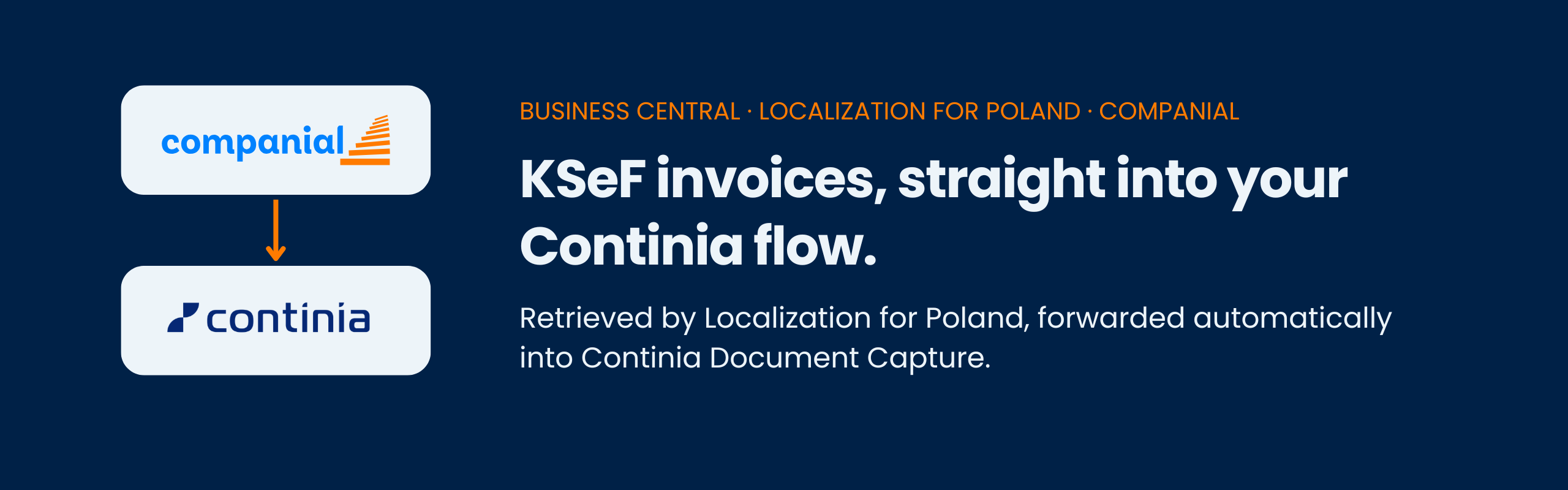
Localization for Poland and Continia Document Capture: bridging KSeF compliance with purchase invoice automation
In the Polish Business Central landscape, compliance with KSeF is only part of the story. The real challenge for many customers begins after the invoice is received: how to process it efficiently within existing purchase invoice workflows. For organizations using both Localization for Poland and Continia Document Capture, this has typically meant dealing with a gap between compliance and operational automation. While Localization for Poland ensures correct retrieval and handling of KSeF invoices, Continia provides advanced tools for processing and posting purchase invoices. Connecting these two areas in a clean, repeatable and efficient way has not been straightforward before. Companial addresses this with a dedicated integration application that links Localization for Poland with Continia Document Capture, enabling automatic transfer of incoming KSeF invoices via the Continia Delivery Network. This creates a practical bridge between compliance and automation – without introducing custom integrations that are difficult to maintain over time. From compliance to process continuity KSeF defines how invoices are exchanged and structured, but it does not define how organizations handle them internally. Each customer has their own processes, approval flows and operational requirements. Localization for Poland covers the compliance layer – including KSeF communication and data structures – ensuring that invoices are correctly retrieved and stored as e‑documents. However, this is only the starting point of the purchase invoice lifecycle. The integration with Continia extends this standard flow by ensuring that once a document is processed in Localization for Poland, it can seamlessly continue into the Continia Document Capture process. How the integration works The integration focuses on incoming purchase invoices retrieved from KSeF and follows a structured, automated flow: Localization for Poland retrieves purchase invoices from KSeF into Business Central. Each document is created as an e-document with the related XML file imported from KSeF attached to it. The XML file is then automatically forwarded to the Continia Delivery Network. The invoice becomes available in Continia Inbound E-Documents. Further processing – including recognition, matching and posting – is handled within Continia Document Capture, based on the relevant Continia configuration. The transfer is triggered automatically once the integration is enabled, assuming the required setup is in place on both sides. A standard approach instead of custom integration A recurring challenge in KSeF-related implementations is the need to connect compliance processes with customer-specific workflows. This could lead to custom integrations that increase complexity and make future updates harder to manage. This application follows a different approach. It does not replace the standard KSeF process delivered by Localization for Poland, nor does it modify Continia functionality. Instead, it acts as a dedicated, standard bridge between the two, allowing both solutions to remain aligned with their respective update cycles. If the integration is disabled, the standard KSeF flow in Localization for Poland continues unchanged. What this means in practice For customers, the key benefit is process continuity: KSeF invoices are automatically transferred into the Continia processing flow, no separate handover or manual intervention is required once the integration and required Continia setup are in place, existing Continia-based automation can continue to be used, the overall purchase invoice process remains consistent and scalable. For partners, this simplifies solution design. Instead of building and maintaining custom “connectors”, they can rely on a predefined integration scenario that aligns with standard Business Central architecture. Observability and control Automation does not remove the need for visibility. The integration provides a dedicated setup and logging mechanism, allowing users to: enable or disable the transfer process, review document transfer history, monitor success and failure statuses, manage retention of upload logs. This ensures that the transfer process is not only automated, but also traceable and easier to support. Where this fits in customer scenarios The integration is particularly relevant in environments where: KSeF is already used or being implemented in Business Central, Continia Document Capture is part of the purchase invoice process, customers want to avoid process-specific integrations (processes may change in time), long-term maintainability is a priority. In such cases, the application provides a clean transition from regulatory compliance to operational processing. Closing the gap between systems As KSeF adoption became mandatory, more organizations are moving toward fully digital invoice processes. At the same time, they expect these processes to remain efficient and integrated. By connecting Localization for Poland with Continia Document Capture, this application addresses a specific but common challenge: how to move KSeF invoices into an existing automation workflow without adding unnecessary complexity. It reflects a broader shift in how Localization for Poland supports customers – from isolated compliance handling toward integrated, end-to-end process design. Availability The application is available on Microsoft Marketplace as Localization for Poland – Continia Integration. For organizations already using both Localization for Poland and Continia Document Capture, it provides a ready and maintainable way to connect KSeF invoice retrieval with purchase invoice automation, while keeping each solution responsible for its own part of the process.
RadosławDudziak
The True Cost of a Lack of Data. All About the Role of OEE and TEEP Indicators
“If you can’t measure it, you can’t improve it.” It is hard to disagree with the words of the CEO of one of the factories we have worked with. Without precise data regarding the time and money spent on production downtime, it is difficult to maintain control over the performance of your machinery park. Moreover, simply having an ERP system will not solve the problem if the production floor lacks MES-class tools. True control over production begins with properly defining downtime categories. It is also necessary to distinguish between key performance indicators – OEE and TEEP. OEE and TEEP Indicators – What Do They Measure and How Do They Differ? Understanding the current equipment effectiveness at the level of a production shift requires the use of appropriate indicators. In the case of the Operator Platform, the Machine Status Monitoring module allows for an in-depth analysis using two key measures: OEE (Overall Equipment Effectiveness) – This indicator is based exclusively on the scheduled production time. It shows the utilization of a machine during the time it was actually scheduled to run. OEE consists of three components: availability, performance, and quality. If a machine runs for one shift (8 hours) and achieves ideal parameters during this time, its OEE will be 100%. Thus, the indicator allows not only for the optimization of production but also for the identification of losses during the shift. TEEP (Total Effective Equipment Performance) – A measure that takes into account the total calendar time – 24 hours a day, 7 days a week, 365 days a year. Therefore, it shows the maximum potential of the factory, taking into account so-called planned losses (e.g., holiday breaks). Because of this, a machine that runs for one 8-hour shift a day will have a TEEP of only 33%. This is due to the fact that it is turned off for the remaining 16 hours. Why is this so important? OEE shows where we are losing money due to breakdowns, changeovers, and micro-stops. TEEP, on the other hand, reveals the hidden capacity of the factory. It often proves that instead of spending millions on new production lines, it is enough to invest in an additional shift or optimize planning in the ERP system. How to Properly Categorize Downtime? Before we start analyzing the smallest micro-stops, the main groups of line stoppages must be properly defined. Implementing a system like Operator MES forces an organization to structure its losses. The foundation is a clear division into planned and unplanned downtime. Planned downtime includes machine changeovers, scheduled maintenance, or employees’ breakfast breaks. Unplanned downtime, on the other hand, includes mechanical failures, speed losses, and shortages of production materials. Thanks to the Operator Datalogger module, connected to terminals on the shop floors, the system gains full context: Cause tree – Downtimes are categorized hierarchically, which allows for the analysis of the sources and frequencies of individual events. Context from the operator – Using a terminal, the operator manually assigns a detailed cause code. They can also add notes, which may concern, for example, the machine operating at a reduced speed. The truth about changeovers – The system precisely separates actual production time from machine setup time. This is often the largest area of hidden losses in manufacturing plants. A Step into the Future with AI Once manufacturing plants master the basics – defining downtimes and starting to measure OEE and TEEP – they can reach for the most advanced tools. The Operator OEE solution, integrated with the Manufacturing Intelligence platform, offers support at the level of artificial intelligence. Machine learning algorithms provide optimization recommendations based on historical data and performance patterns. The ACIP (Automated Continuous Improvement Process) mechanism uses AI to predict potential quality problems and anomalies in machine operation. Are you looking for a technology partner who can help with the proper implementation of an MES system and a precise downtime grid? We encourage you to contact us and schedule a software demo.
JakubJaszczur